

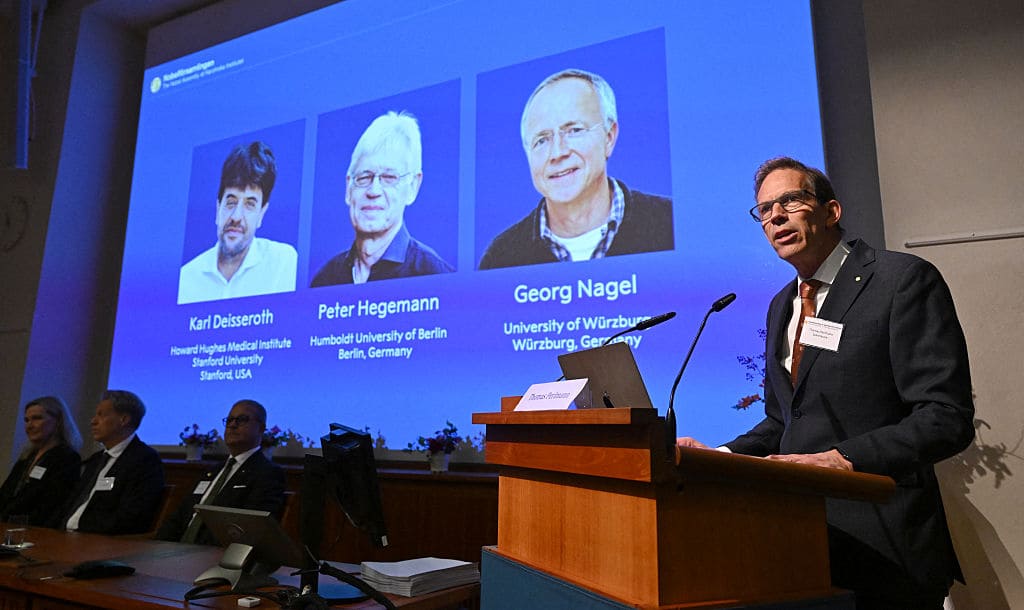
The 2026 Nobel Prize in Medicine was awarded jointly to Karl Deisseroth (Stanford University), Peter Hegemann (Humboldt University of Berlin), and Georg Nagel (University of Würzburg). The Nobel Assembly at Karolinska Institutet recognized the laureates “for their discoveries concerning light-gated ion channels and optogenetics,” an innovation that has fundamentally redefined modern neuroscience.
The foundational research by Hegemann and Nagel on microbial rhodopsins demonstrated that single proteins can act directly as light-activated ion channels, providing the biophysical basis for optogenetics. Deisseroth successfully engineered these channels into mammalian neurons, establishing a method to optically control targeted neuronal populations with millisecond precision.
In basic research, this methodology introduced unprecedented spatial and temporal resolution, allowing neuroscientists to manipulate neural circuits and cognitive processes at the millisecond scale. Beyond fundamental physiology, optogenetics quickly inspired translational avenues, showing therapeutic potential in restoring vision in degenerative retinal diseases and modulating aberrant circuit activity in disorders such as epilepsy and Parkinson’s disease. Addressing technical constraints for its safe translation into non-human primates and human applications represents the next frontier of this technology.
Our Society acknowledges this significant recognition for research that continues to shape modern neuroscience.
