

TDP-43-dependent mis-splicing of KCNQ2 triggers intrinsic neuronal hyperexcitability in ALS/FTD
Publication date: 31/10/2025
Authors: Joseph BJ, Marshall KA, Harley P, Mann JR, Alessandrini F, Vanoye CG, Chi W, Prudencio M, Simkin D, Kao TT, Desai RR, Keuss MJ, Barattucci S, Zanovello M, Mehta PR, DeKeyser JM, Limone F, Lee J, Brown
Journal: Nature Neuroscience
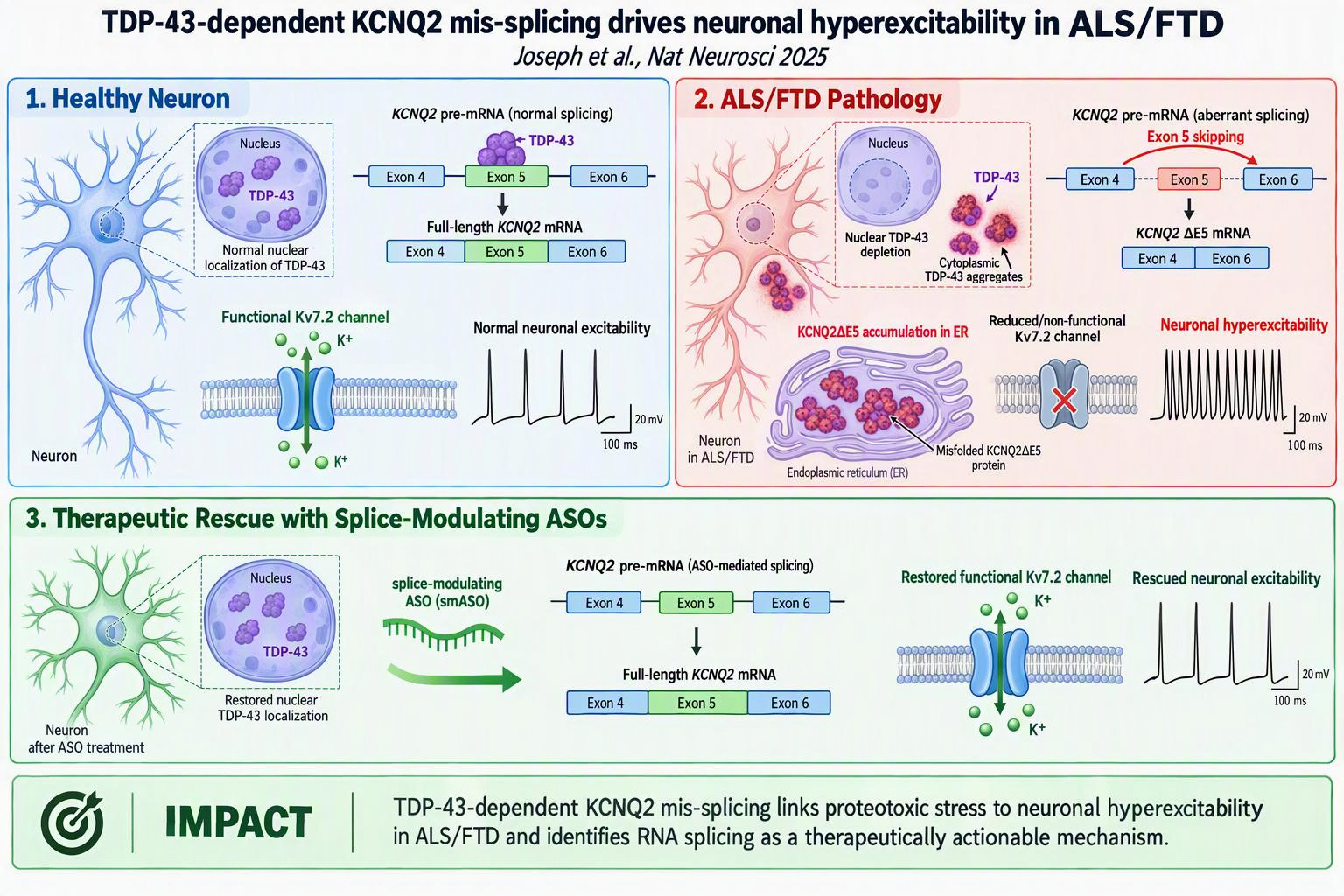
Commentary: The study by Joseph et al. investigates the molecular mechanisms underlying neuronal hyperexcitability, a hallmark of amyotrophic lateral sclerosis (ALS) and frontotemporal dementia (FTD). Through transcriptomic analyses of TDP-43-depleted neurons, the authors identified aberrant skipping of exon 5 in KCNQ2, encoding the Kv7.2 voltage-gated potassium channel subunit, whose mutations are associated with different forms of epilepsy. The authors demonstrated that the resulting KCNQ2(ΔE5) isoform exhibits severely impaired channel function compared with its wild-type counterpart. Furthermore, KCNQ2(ΔE5) accumulates within the endoplasmic reticulum (ER), indicating defective trafficking to the plasma membrane. Interestingly, this aberrant isoform also exerts dominant-negative effects on wild-type KCNQ2, further compromising channel activity and membrane localization. These alterations impair the M-current, which normally limits repetitive neuronal firing, thereby promoting hyperexcitability. Importantly, treatment with splice-modulating antisense oligonucleotides (ASOs) restored proper KCNQ2 splicing and significantly reduced hyperexcitability in TDP-43-depleted cortical neurons and spinal motor neurons. The authors also investigated postmortem spinal cord tissue from ALS patients, observing intracellular KCNQ2 accumulations frequently associated with the ER and, in some instances, co-aggregating with phosphorylated TDP-43. However, these observations were obtained from end-stage disease tissue and do not directly demonstrate that the accumulated protein originates from aberrantly spliced KCNQ2 transcripts. Overall, this study provides novel mechanistic insights into how TDP-43 nuclear loss of function contributes to neuronal hyperexcitability through KCNQ2 mis-splicing. These findings emphasize the importance of investigating loss-of-function mechanisms alongside the proteotoxic effects associated with cytoplasmic TDP-43 aggregation. Although the contribution of this mechanism to disease progression remains to be established, the study identifies KCNQ2 splicing as a promising therapeutic target and highlights the potential of ASO-based approaches to counteract neuronal dysfunction in ALS.
Commented by: Matteo Bordoni
DOI: https://doi.org/10.1038/s41593-025-02096-w
