

A corticohypothalamic circuit that mediates maternal awakening to pup cries
Publication date: 21/10/2026
Authors: Tang P., Wu K., Pan Y., Yang S., Cai Z., Liang Y., Mai F., Chen P., Peng M., Wang Y., Chen X., Song C., Ji X. & Liang F.
Journal: Nature Neuroscience
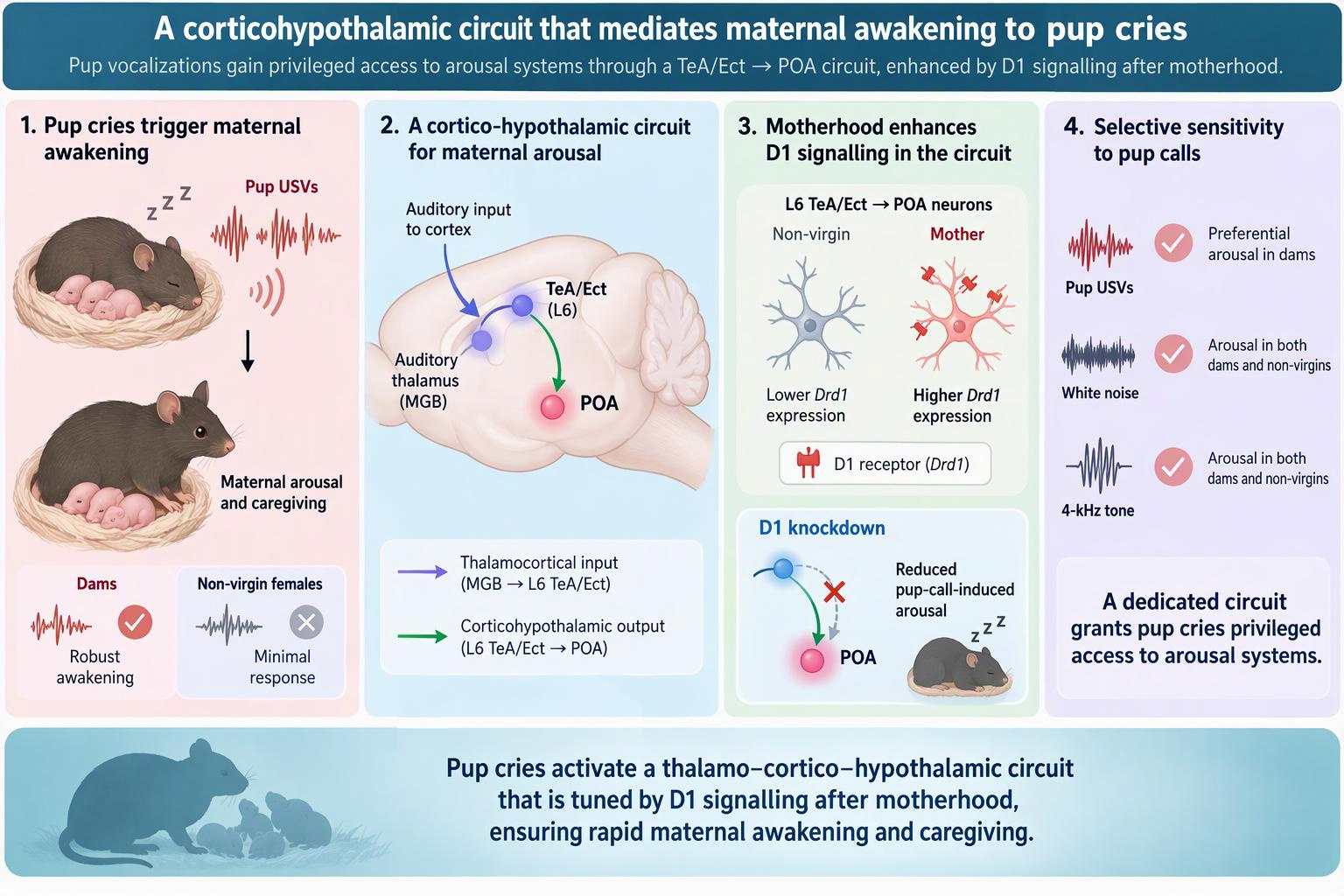
Commentary: In the present work, Tang and colleagues elegantly demonstrate how mammalian mothers awaken to their infants’ cries. Contrary to the common view that motherhood lowers arousal thresholds, the authors show that, following parturition, dams selectively prioritize pup vocalizations over other auditory stimuli. This adaptive mechanism preserves the physiological functions of sleep while ensuring rapid activation of maternal behaviors when offspring require care. By exposing dams and non-maternal female mice to pup ultrasonic vocalizations (USVs) while recording EEG and EMG activity, the authors demonstrate that pup calls reliably induce sleep-to-wake transitions only in mothers. Importantly, this effect is specific to pup USVs and is not observed with other sounds or noise. Using complementary chemogenetic approaches and in vivo calcium imaging, Tang et al. identify a previously unrecognized corticohypothalamic circuit, formed by layer 6 neurons in the TeA/Ect that project to the POA, as the neural substrate underlying this behavior. Remarkably, this circuit is present in both non-maternal females and males but is selectively recruited by pup vocalizations only in dams, although its artificial activation is sufficient to induce awakening. Finally, the authors demonstrate a critical role for D1 receptor signaling within this circuitry, while excluding a major contribution of oxytocin, a hormone traditionally linked to maternal behaviors. Overall, this study identifies a dedicated corticohypothalamic circuit that enables infant vocalizations to selectively override sleep and trigger maternal awakening. It provides a mechanistic explanation for how the maternal brain prioritizes offspring-related cues over competing environmental stimuli revealing a role for D1 receptor-dependent plasticity in maternal sensory processing and arousal. These results may inform future research on postpartum sleep disturbances, caregiving deficits, and neuropsychiatric conditions affecting parent-infant interactions.
Commented by: Jessica Mingardi
DOI: https://doi.org/10.1038/s41593-026-02458-y
