

Developmental xenocortication using human-derived organoids in mice
Publication date: 16/09/2026
Authors: Kaganovsky K, Kelley KW, Gschwind T, Harary PM, Kochalka J, White AD, Lerma-Usabiaga G, Chen X, Revah O, Gore F, Aoyama A, Shadrach JL, Yoon SJ, Valencia A, Ogawa S, Reis N, Vogel H, Wandell B, Kaltsc
Journal: Nature
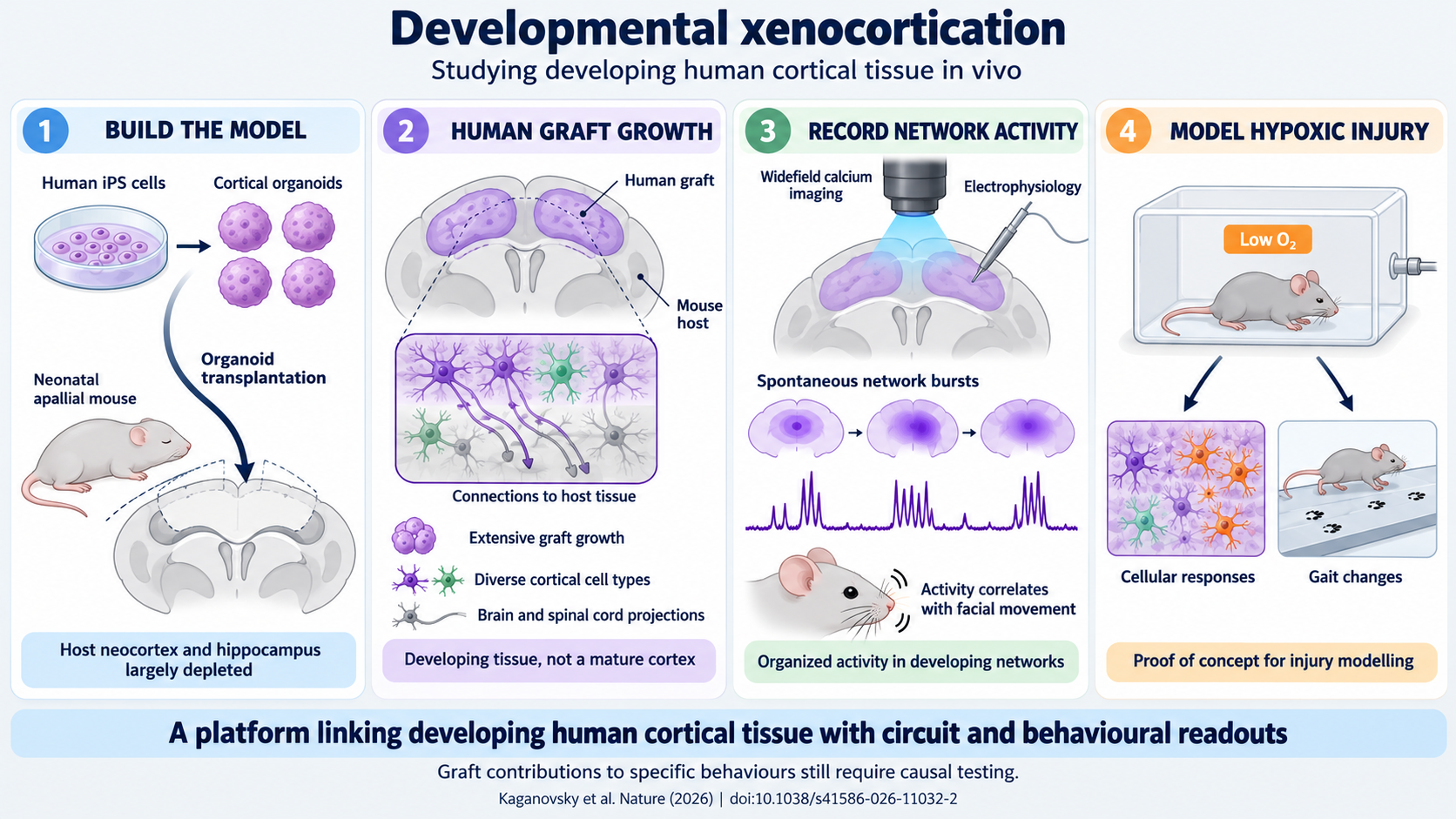
Commentary: Studying human cortical development in vivo remains challenging because existing organoid transplantation models are constrained by limited space and competition with host circuits. Kaganovsky and colleagues introduce developmental xenocortication, a platform in which human cortical organoids are transplanted into neonatal immunodeficient mice genetically depleted of most neocortical and hippocampal glutamatergic neurons. The grafts expand extensively, generate diverse cortical cell types, including layer 5 extratelencephalic projection neurons, and establish anatomical connections with the host brain and spinal cord. Calcium imaging and electrophysiology reveal organized activity resembling developing neural networks. Behavioural analyses show broadly preserved locomotion alongside altered coordination and spontaneous behavioural organization. Following hypoxia, xenocortical mice exhibit graft cellular responses and gait changes, providing a proof of concept for linking injury to developing human tissue with behavioural readouts. The study's principal contribution is a platform that brings human cellular biology into an experimentally accessible setting spanning tissue, circuits and behaviour. This could help researchers investigate neurodevelopmental disorders and assess interventions across levels of organization. Its value will depend on establishing which outcomes specifically report human neuronal function and whether those outcomes are reproducible across donor lines and developmental stages. Several limitations therefore shape interpretation. The graft remains developmentally immature and lacks canonical cortical layering, while its necessity or sufficiency for particular behaviours has not been demonstrated. Selective, reversible manipulation of graft neurons would be a decisive next step. Overall, xenocortication opens new opportunities for human neuroscience while making functional validation and ethical oversight central to the platform's future development.
Commented by: Stefano Raffaele
DOI: 10.1038/s41586-026-11032-2
