

Multilevel sex-influenced neurobiological signatures of early life adversity
Publication date: 27/08/2026
Authors: Narayana S, Beer C, Kovarova V, Castoldi C, Stark T, Dal Bianco B, Röh S, Sauer S, Bordes J, Karamihalev S, Mitra S, Maidana Miguel P, Alberry B, Czamara D, Silveira PP, Czisch M, Silva B, Binder EB,
Journal: Proceedings of the National Academy of Sciences of the United States of America (PNAS)
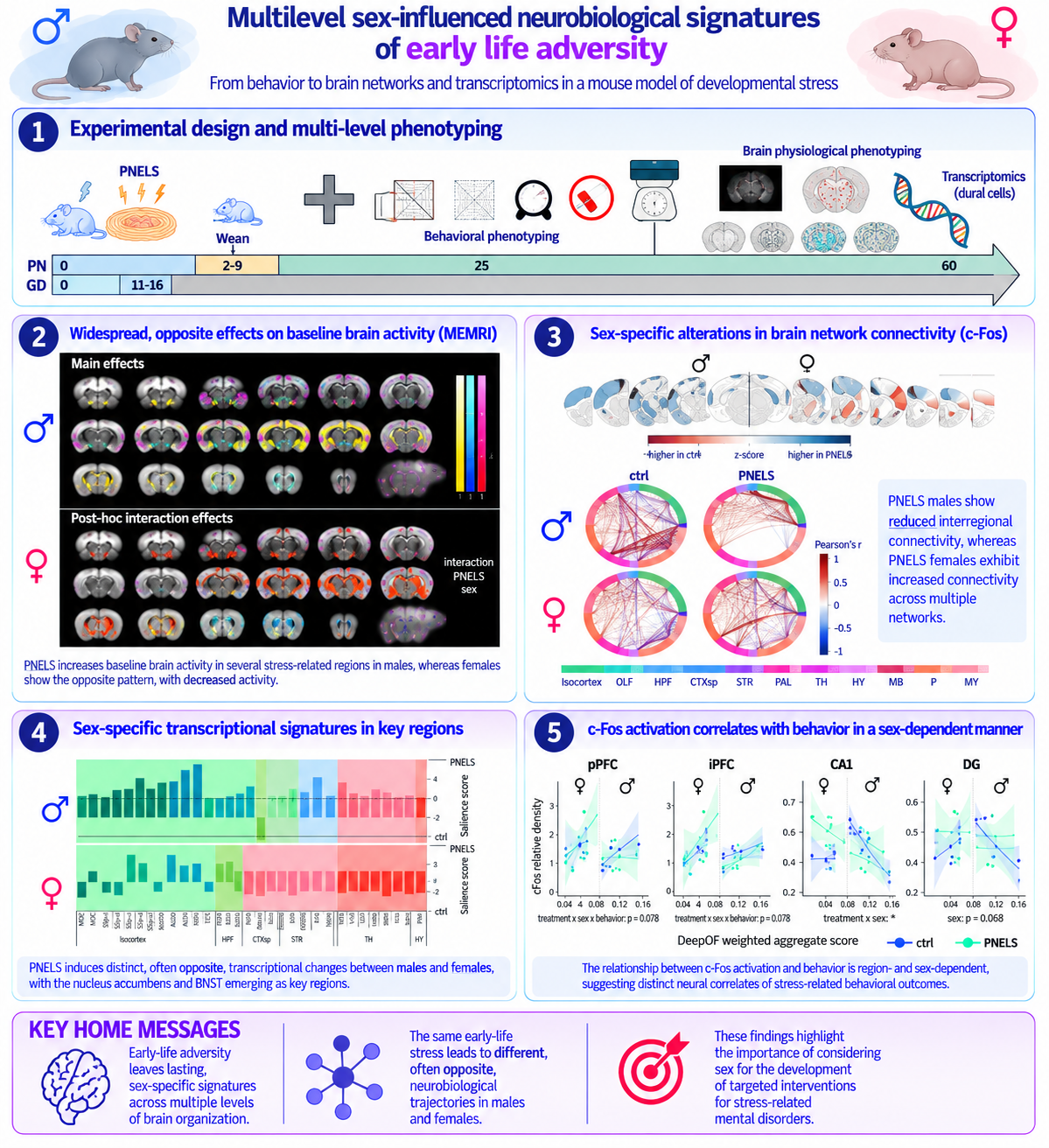
Commentary: The study provides a comprehensive investigation of how early life adversity produces long-lasting, sex-influenced alterations in behavior and brain function. The authors used a translational mouse model combining prenatal corticosterone exposure with limited bedding and nesting during the early postnatal period (PNELS), and integrated deep behavioral phenotyping with manganese-enhanced magnetic resonance imaging (MEMRI), whole-brain c-Fos mapping, and bulk RNA sequencing across multiple stress-related brain regions.
Developmental stress produced persistent behavioral alterations in adulthood, with marked differences between males and females. PNELS reduced behavioral flexibility and altered social dominance and reward-related behavior, while several effects on reward processing and task performance differed according to sex. At the neurobiological level, MEMRI revealed widespread sex-influenced changes in sustained brain activity, with stress-related activity changes often occurring in opposite directions in males and females. Consistently, whole-brain c-Fos mapping showed distinct functional network adaptations: PNELS males displayed reduced interregional connectivity, whereas PNELS females showed increased connectivity strength and density.
Transcriptomic profiling further demonstrated that the molecular consequences of developmental stress were highly region- and sex-dependent. Most differentially expressed genes were specific to individual brain regions, while the nucleus accumbens and bed nucleus of the stria terminalis emerged as particularly relevant sites of male-female transcriptional divergence. Cross-species comparison with postmortem transcriptomic data from individuals with major depressive disorder revealed limited overall concordance but sex- and region-dependent patterns of overlap.
Collectively, these findings demonstrate that biological sex strongly shapes the long-term behavioral, circuit-level, and molecular consequences of early life adversity, emphasizing the importance of sex-informed approaches for understanding vulnerability and resilience to stress-related psychiatric disorders.
Commented by: Giulia Federica Mancini
DOI: 10.1073/pnas.2603982123
